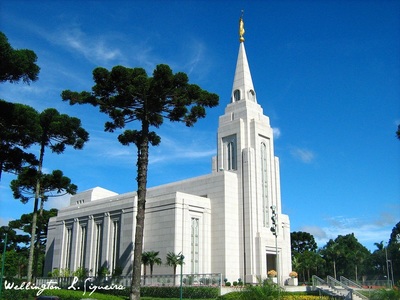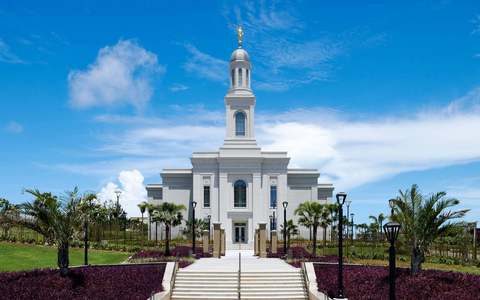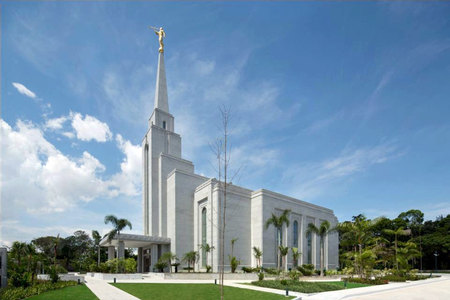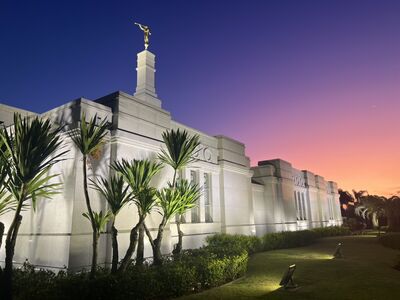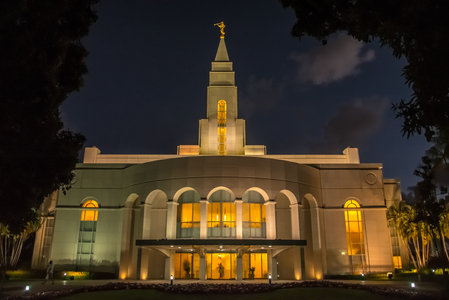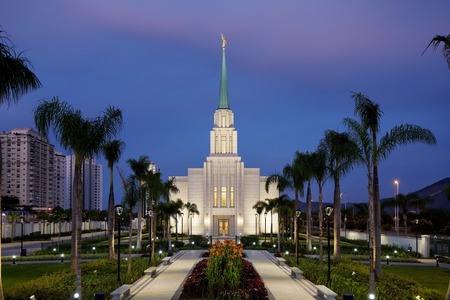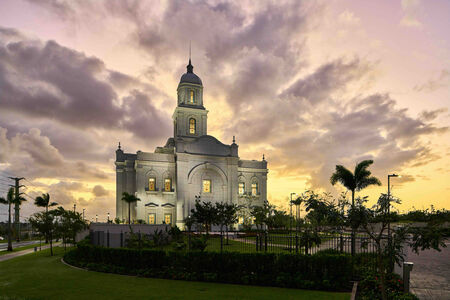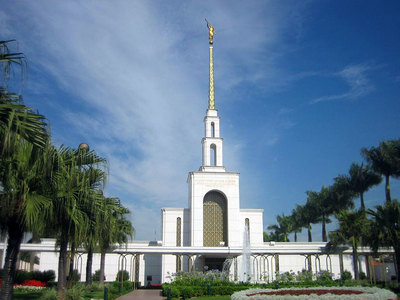
Yorba Linda California Temple
Cleveland Ohio Temple
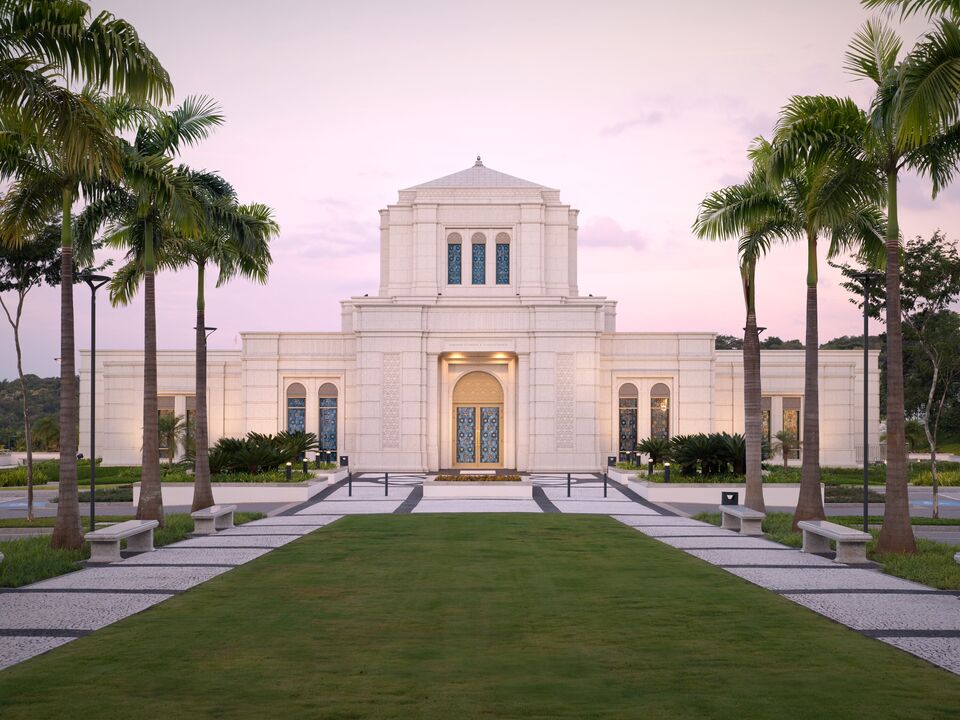
Belo Horizonte Brazil Temple
220th dedicated temple in operation
© Intellectual Reserve, Inc. All rights reserved.
Services
NO visitors' center open to the publicNO arrival center available
Patron housing available
Distribution center on site (Store Locator)
Announcement:
4 April 2021Groundbreaking and Site Dedication:
17 June 2023 by Juan A. UcedaPublic Open House:
13–27 June 2026 | 14 daysDedication:
16 August 2026 by Dallin H. OaksSite:
6.029 acres | 2.4 hectaresExterior Finish:
Brazilian Branco Ceará graniteArchitectural Features:
Single attached central tower with a pyramid roofOrdinance Rooms:
Two instruction rooms, two sealing rooms, and one baptistryTotal Floor Area:
28,686 square feet | 2,665 square metersHeight:
62 feet 3 inches | 19.0 metersElevation:
2,740 feet | 835 metersTemple Locale
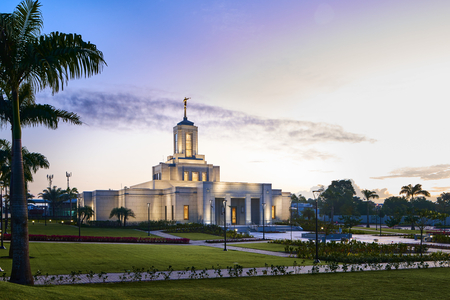
The Belo Horizonte Brazil Temple is located on a hillside along Rua Professor José Vieira de Mendonça in the Engenho Nogueira neighborhood of Belo Horizonte. The landscaped property incorporates native and climate-adapted plants surrounded by a dark-gray galvanized steel fence. Interlocking and precast concrete pavers form the walkways, while the plaza areas are distinguished by traditional Portuguese-style black-and-white stone paving, echoing the Portuguese tile patterns that inspired architectural details throughout the temple.
Temple Facts
The Belo Horizonte Brazil Temple was the twelfth temple built in Brazil and the first built in Minas Gerais.
Before the Belo Horizonte Brazil Temple was dedicated, the nearest temple for members was located approximately 280 miles (450 kilometers) away in the city of Rio de Janeiro Brazil Temple.
The Belo Horizonte Brazil Temple was dedicated on the same day as the Cleveland Ohio Temple.
The exterior of the Belo Horizonte Brazil Temple is clad in Branco Ceará granite, a Brazilian stone that has also been used on other temples in Brazil.
Much of the design for the Belo Horizonte Brazil Temple draws inspiration from the traditional Portuguese tile patterns found throughout Minas Gerais. Geometric and floral motifs appear in the interior, while circular mandala patterns are incorporated into painted friezes and ceilings. The art-glass windows feature white, yellow, and multiple shades of blue, with patterns also inspired by the tiles.
Tauari wood, native to Brazil, is used for the millwork inside the Belo Horizonte Brazil Temple. Interior flooring includes locally manufactured porcelain tile and Calacatta Michelangelo Supreme marble.
Temple History
Announcement
The Belo Horizonte Brazil Temple was announced by President Russell M. Nelson at the 191st Annual General Conference on April 4, 2021. It would join the Belém Brazil Temple, Brasília Brazil Temple, Campinas Brazil Temple, Curitiba Brazil Temple, Fortaleza Brazil Temple, Manaus Brazil Temple, Porto Alegre Brazil Temple, Recife Brazil Temple, Rio de Janeiro Brazil Temple, São Paulo Brazil Temple, São Paulo Brazil East Temple, and Salvador Brazil Temple. There were more than 1.4 million members of the Church in more than 2,100 congregations in Brazil at the time of the announcement. The first known Latter-day Saint to live in Brazil emigrated from Germany in 1913. In 1986, Brazil became the third country outside of the United States to have 50 stakes.1
Site
On September 23, 2021, the location of the Belo Horizonte Brazil Temple was announced as an 11.8-acre site on Rua Professor Jose Vieira de Mendonça in Belo Horizonte. Plans called for a single-story temple of approximately 27,000 square feet.2
Rendering
On September 23, 2021, the official exterior rendering of the Belo Horizonte Brazil Temple was released.
Groundbreaking
On Saturday, June 17, 2023, the groundbreaking ceremony was held for the Belo Horizonte Brazil Temple under the direction of Elder Juan A. Uceda of the Brazil Area presidency. He was accompanied by his wife, Maria Isabel, and Elder Luciano Sankar, an Area Seventy. Approximately 500 guests were in attendance including government officials. In his site dedicatory prayer, Elder Uceda implored the Father saying: "I ask Thee, dear Father, that this place and all who live within the boundaries of the temple district enjoy special protection. And may the light of the gospel shine throughout this region. We pray that no influence will stop or delay the building of the temple and that in due time it will be dedicated as the house of the Lord. May Thy spiritual power be strongly felt in this region."3
Open House and Dedication
The open house for the Belo Horizonte Brazil Temple began with a media day held on Wednesday, June 10, 2026, followed by two days of private tours for invited guests. Tour for the public were conducted from Saturday, June 13, through Saturday, June 27, 2026 (excluding Sundays). President Dallin H. Oaks, the 18th president of the Church, dedicated the temple on Sunday, August 16, 2026. The dedicatory session was broadcast to all units in the temple district.4
Temple Design
Exterior
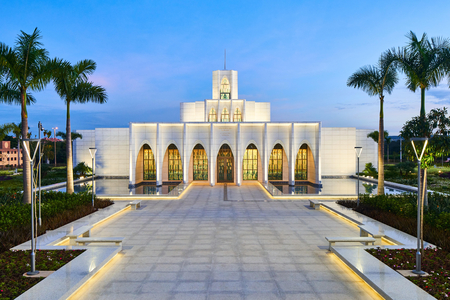
The Belo Horizonte Brazil Temple is a single-story concrete structure with a central tower positioned above the celestial room. The exterior is clad in Brazilian granite known as Branco Ceará, a stone also used on other temples throughout Brazil. The structure is made of precast concrete, with structural steel in the tower.
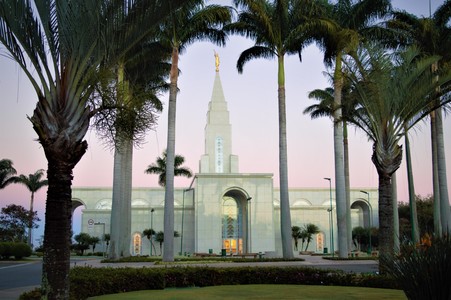
The pyramid-shaped central tower rises 19 meters high and is fully clad in Branco Ceará granite, creating a unified appearance with the rest of the building.
The exterior art glass design is inspired by traditional Portuguese tile patterns common in the state of Minas Gerais. The color palette includes white, yellow and multiple shades of blue. This art glass is featured throughout the facade, inside the baptistry and confirmation room and in some interior doors. It was designed and manufactured by Vitrais Ton Geuer, a Brazilian art glass studio based in Campinas, São Paulo.
The landscape design incorporates native and climate-adapted plant species selected for durability and ease of maintenance. The landscaping adds beauty, color and harmony to the site without distracting from the importance of the building. The landscape architect is Sergio Santana Planejamento e Desenho da Paisagem, based in São Paulo, Brazil.
The perimeter fence is constructed of galvanized steel painted dark gray. Walkways and hardscape areas use interlocking and precast concrete pavers, while plaza areas feature traditional Portuguese-style black-and-white stone paving.
Interior
The interior accent designs also draw inspiration from local Portuguese tile patterns, incorporating geometric and floral motifs to reflect regional cultural influences and create a reverent atmosphere. Decorative painting appears on friezes and ceilings, featuring circular mandala patterns from the same Portuguese tiles, giving a unified theme within and outside the temple. Finishes include gold leaf accents and coordinated blue, gold and beige tones. Ordinance and waiting areas feature plaster ceilings with decorative painted linework. The decorative painting was completed by Visual Point, with additional painting by Artbella and Calacina.
Flooring throughout the temple includes locally manufactured Portinari Calacata Real porcelain tile paired with Calacatta Michelangelo Supreme marble thresholds. Carpeted areas use products from Tecer Tapetes in various textures and colors. Instruction rooms feature decorative carpet tile in shades of blue with golden yellow details, manufactured by Milliken. Quarry tile is used in facilities areas, and epoxy flooring is used in mechanical spaces.
The interior art glass follows the same design language and pattern as the exterior art glass and is installed in select doors and interior locations. The glass panels are designed in white, yellow and various shades of blue. All art glass was manufactured by Vitrais Ton Geuer of Campinas, São Paulo.
Crystal chandeliers are installed in the celestial room, sealing rooms and bride’s room. Decorative pendants are used in other patron areas, such as the entry, waiting room, baptistry and instruction rooms. All decorative lighting and chandeliers were manufactured by Scatto Lampadário of Belo Horizonte, Minas Gerais.
Millwork throughout the temple is crafted from native Brazilian tauari wood and is used for cabinetry, pews and architectural detailing. In ordinance spaces, the crown molding, some columns, and base elements are painted white. The celestial room features applied millwork columns. Millwork fabrication was completed by Móveis Reeps, Móveis e Decorações Visoma and Fenix Móveis Especiais, all based in Brazil.
The baptismal font railings consist of clear glass panels supported by a metal structure with a matte gold finish and a tauari wood handrail. The railings were fabricated by Latão Arte in São Paulo, Brazil.
The door hardware was designed specifically for the Belo Horizonte temple and is made of brass with a gold finish. Hardware was supplied by ASSA ABLOY BRASIL, with decorative hardware provided by MTA Ferragens.
Original artwork for the temple includes “Mary Teaching the Scriptures to Jesus” by Brazilian artist Clodoaldo Martins and “Sweet Above All That Is Sweet (Mais Doce Que Tudo Que É Doce)” by David Dibble. Both works were created specifically for the Belo Horizonte Brazil Temple and reflect spiritual themes with regional connections.
- The Church of Jesus Christ of Latter-day Saints News Release, "At April 2021 Conference, Prophet Announces 20 More Temples to Be Constructed," 4 Apr. 2021.
- "Temple Site Locations Announced in Four Latin American Countries," The Church of Jesus Christ of Latter-day Saints News Release, 23 Sept. 2021.
- "Ground Broken for Belo Horizonte Brazil Temple," The Church of Jesus Christ of Latter-day Saints News Release, 20 Jun. 2023.
- "Milestones for Temples in Brazil, Guatemala, Nicaragua and Montana," The Church of Jesus Christ of Latter-day Saints News Release, 13 Apr. 2026.