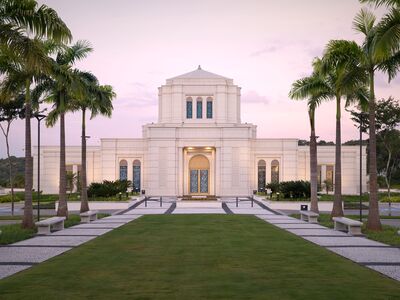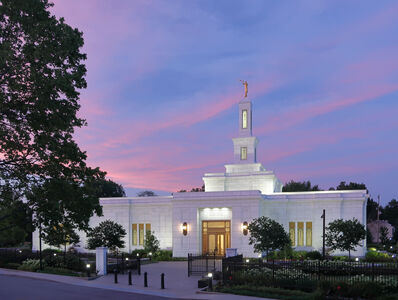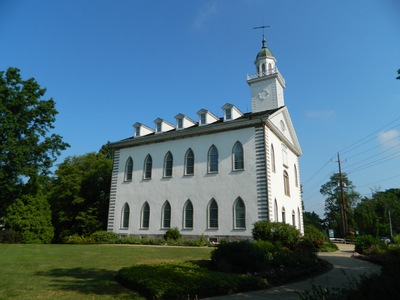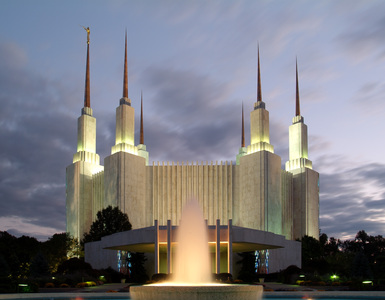
Belo Horizonte Brazil Temple
Phnom Penh Cambodia Temple
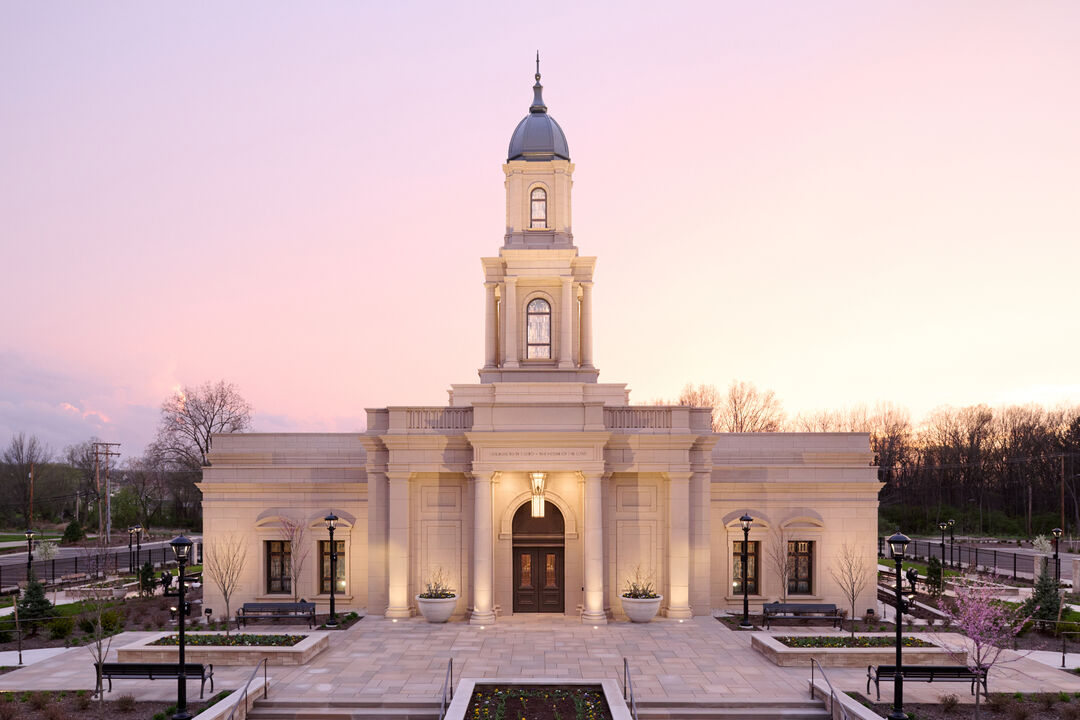
Cleveland Ohio Temple
221st dedicated temple in operation
© Intellectual Reserve, Inc. All rights reserved.
Services
NO visitors' center open to the publicNO arrival center available
NO patron housing available
NO distribution center on site (Store Locator)
Announcement:
3 April 2022Groundbreaking and Site Dedication:
1 June 2024 by Vaiangina SikahemaPublic Open House:
18 June–3 July 2026 | 15 daysDedication:
16 August 2026 by David A. BednarSite:
11.04 acres | 4.5 hectaresExterior Finish:
Spanish Burdur Beige marble and Brazilian Azul Macaubus marbleArchitectural Features:
Single attached central towerOrdinance Rooms:
One instruction room, one sealing room, and one baptistryTotal Floor Area:
9,950 square feet | 924 square metersHeight:
100 feet | 30.5 metersElevation:
733 feet | 223 metersTemple Locale
The Cleveland Ohio Temple is located along Brecksville Road in the Cleveland suburb of Independence. The property is situated about eight miles from the southern shore of Lake Erie and approximately 20 miles southwest of the historic Kirtland Temple, giving the temple a notable connection to early Church history. The temple rises 100 feet to the top of its central spire and is surrounded by beautifully landscaped grounds. The property also includes parking areas, pedestrian walkways, and an ancillary building supporting the temple's operations.
Temple Facts
The Cleveland Ohio Temple was the third temple built in Ohio but is the second dedicated temple in operation in the state, following the Columbus Ohio Temple (1999). The Kirtland Temple, dedicated in 1836, ceased operation as a temple in the late 1830s and now operates as a historic Church building.
President Russell M. Nelson announced the Cleveland Ohio Temple as one of 17 temples announced at the conclusion of the April 2022 general conference. Those 17 announcements brought the total number of temples announced by President Nelson to 100.
The Cleveland Ohio Temple was dedicated on the same day as the Belo Horizonte Brazil Temple.
The design of the Cleveland Ohio Temple incorporates motifs drawn from Cleveland's architectural heritage. Diamond patterns in the art glass were inspired by historic Cleveland buildings, including the Cleveland Trust Building, Cleveland Public Library, and Terminal Building. Decorative frieze bands were adapted from Cleveland City Hall and the Cuyahoga County Court House.
Lake Erie inspired the color scheme of the Cleveland Ohio Temple. The interior colors of blue, green, red, coral, and gold were selected to evoke the appearance of the Lake Erie hillside at sunrise and the colorful buildings along Cleveland's East 4th Street.
Ohio's state wildflower, the white trillium, is prominently featured in the Cleveland Ohio Temple. Its three-petaled white blossom appears in both architectural and interior details.
Temple History
Announcement
On April 3, 2022, President Russell M. Nelson announced plans to construct the Cleveland Ohio Temple at the April 2022 General Conference. Cleveland is located along the southern shore of Lake Erie about 20 miles from the Church’s first temple in Kirtland. The Kirtland Temple was dedicated in 1836, but it ceased operation as a temple a few years later. As a Church historic building, it is open to the public for walking tours. The temple in Cleveland became the state's second dedicated temple in operation, following the Columbus Ohio Temple, which was dedicated in September 1999. There were more than 63,000 Latter-day Saints in approximately 125 congregations in Ohio at the time of the announcement.1
Site
On December 19, 2022, the location of the Cleveland Ohio Temple was announced as a parcel of property on Brecksville Road (south of Longano Drive) in Independence, Cuyahoga County. Plans called for a single-story temple of approximately 9,000 square feet with a 100-foot spire. A 2,200-square-foot ancillary building would provide a non-patron waiting area, restrooms, break room, and storage for grounds and maintenance equipment.2
Rendering
On July 25, 2023, the official exterior rendering for the Cleveland Ohio Temple was released to the public.3
Groundbreaking
Elder Vaiangina Sikahema, First Counselor in the North America Northeast Area Presidency, presided at the groundbreaking for the Cleveland Ohio Temple on Saturday, June 1, 2024. "So many of you are pioneers in this area and have made this day possible, and we thank you," said Elder Sikahema. During his dedicatory prayer, he expressed gratitude for the early Saints who gathered in Kirtland, Ohio, saying, "Holy Father, we stand here now nearly two centuries from those difficult days, blessed because Thy people followed the Prophet Joseph to this great land of Ohio."4
Open House and Dedication
The open house for the Cleveland Ohio Temple began with a media day held on Monday, June 15, 2026, followed by two days of private tours for invited guests. Public tours of the new temple were conducted from Thursday, June 18 through Friday, July 3, 2026, excluding Sundays. Elder David A. Bednar of the Quorum of the Twelve Apostles presided at the dedication on Sunday, August 16, 2026. The dedicatory session was broadcast to all units in the temple district.5
Temple Design
The temple’s design motifs draw from Cleveland’s rich architectural heritage, incorporating elements found in the city’s historic buildings. The white trillium, Ohio’s state wildflower, recognized by its three-petaled white blossoms, serves as a central design element. Diamond patterns inspired by the Cleveland Trust Building’s art glass, the Cleveland Public Library’s ceilings and the Terminal Building appear throughout the interior. Decorative frieze bands adapted from Cleveland City Hall and the Cuyahoga County Court House add historical depth, while a color palette of blue, green, red, coral and gold reflects the hillside of Lake Erie at sunrise and the vibrant buildings along East 4th Street.
Exterior
The temple is constructed with a steel frame clad in glass-fiber-reinforced concrete. Rising 100 feet from the ground to the top of the spire, it stands as a welcoming landmark in the Independence area. The property extends across 11.04 acres, and the temple is enclosed by a standard Ameristar fence.
Interior
Blue-toned floral-pattern broadloom carpet is used in general areas and instruction rooms, while two-toned cream broadloom carpet appears in the veil corridors. Wool area rugs grace the entry and the patron waiting, sealing and celestial rooms. The carpet was fabricated by Milliken of Spartanburg, South Carolina; Bentley Mills of City of Industry, California; and ShawContract of Cartersville, Georgia. The area rugs were fabricated by Rugs International of Cartersville, Georgia, and installed by JNC Design of Salt Lake City, Utah.
The temple’s primary stone is Burdur Beige marble quarried in Spain and fabricated in China, accented with Azul Macaubus marble quarried in Brazil and fabricated in China. Florida Tile’s Tempo Cotton White tiles are used in general areas. The stonework and tile were fabricated and installed by Global Stone and Tile of Orem, Utah.
Warm beige paint is used for all wall surfaces in the temple, tied to the warm color scheme of the flooring and fabrics throughout the interior. The paint was fabricated and installed by The Dependable Painting Company of Cleveland, Ohio.
Decorative paint designs throughout the temple draw from Cleveland’s historic architecture, including floral patterns, bead and barrel motifs and interlocking designs inspired by Cleveland City Hall and the Cuyahoga County Court House. The decorative paint was fabricated and installed by Finessed Finishes of Mapleton, Utah.
Decorative light fixtures combine acrylic, bronze and crystal elements. Crystal chandeliers and sconces illuminate key spaces throughout the temple, creating an atmosphere of sacred elegance. The decorative lighting was fabricated by Preciosa Lighting of the Czech Republic and installed by G & B Electric Company of Brecksville, Ohio.
Quarter-sawn sapele wood is used throughout the temple’s interior. Dovecreek Wood Products of Chula Vista, California, fabricated the millwork, and Gleeson Construction of Chagrin Falls, Ohio, installed the doors, moldings and other wood elements.
The art glass was designed by the Naylor Wentworth Lund Architects interior design team, located in Salt Lake City, Utah, incorporating the diamond patterns and botanical motifs that connect the temple to Cleveland’s architectural heritage. The art glass was fabricated and installed by Glass Images & Creations of Orem, Utah.
The interior doors are quarter-sawn sapele with bronze hardware with an antique brass finish, fabricated and installed by Architectural Building Supply of Salt Lake City, Utah. The interior doors were fabricated by Dovecreek Wood Products of Chula Vista, California, and installed by Gleeson Construction of Chagrin Falls, Ohio. Exterior metal doors were fabricated and installed by Blox of Bessemer, Alabama. The main entry doors were fabricated by Mosti Sistemi of Mexico City, Mexico, and installed by Lakeland Glass of Lorain, Ohio.
The baptismal font railings feature aluminum with an antique brass finish and glass panels. They were fabricated and installed by Wiemann Metalcraft of Tulsa, Oklahoma.
The temple’s ceilings feature gypsum board, acoustic ceiling tile and glass-fiber-reinforced gypsum. The ceiling elements were fabricated by Unlimited Designs of Salt Lake City, Utah, and installed by Cannon Masonry & Construction of South Jordan, Utah.
The temple’s original artwork includes Michael Coleman’s “Lake Erie” and Josh Clare’s “Let the Saints Shout Aloud for Joy.”
Church History in Cleveland
The earliest members of The Church of Jesus Christ of Latter-day Saints came to northern Ohio to follow the teachings of Jesus Christ and build communities of faith and service. They continue to worship the Savior and serve their neighbors today.
In November 1830, missionaries of The Church of Jesus Christ of Latter-day Saints (then known as the Church of Christ) preached in northern Ohio. Sidney Rigdon, an influential reformed Baptist preacher, and his wife, Phebe, heard their message. The Wyandot people living along Lake Erie also welcomed them. While the missionaries’ preaching did not yield converts among the Wyandot, the Rigdons joined the Church and brought many from their congregation.
Other Church members soon received direction through Church founder Joseph Smith to gather in Ohio. They settled above the Chagrin River about 28 miles northeast of Cleveland, in Kirtland Township. The Church grew rapidly there. In April 1832, it was designated a stake (a collection of congregations), with leaders — a presidency and high council — appointed in 1834. By 1837, there were more than 1,500 members in Kirtland and many more in the surrounding region.
Joseph Smith received more than 60 of the Church’s 143 canonized revelations in northern Ohio, establishing the Church’s fundamental organization and restoring important doctrine. Among the most significant were revelations directing the construction of a temple.
Despite the Church members’ poverty and inexperience, they completed the Kirtland Temple in 1836. Observers praised its beauty. Joseph Smith and Church leader Oliver Cowdery reported that the resurrected Jesus Christ visited them in the temple in April 1836. He accepted the building and the Saints’ efforts to build it. They also reported being visited by ancient prophets who conveyed to them priesthood authority vital to the restored Church of Jesus Christ.
The nationwide economic panic of 1837 caused bank failures across the country. It hit Kirtland particularly hard, where the Kirtland Safety Society, an unchartered bank opened by Church leaders, likewise failed. Church members and others in the community lost savings, land and homes. Under threats of mob violence, most Church members left, many to Missouri, abandoning the temple and the stake organized in Kirtland. Eventually, a church known today as Community of Christ acquired the temple. For more than a century, they worshipped in it and cared for it.
Small congregations continued to worship in northeast Ohio, and missionaries preached in the region intermittently during the following decades.
The Church in northern Ohio grew steadily during the first half of the 20th century. The Cleveland Ohio Stake was organized in 1961. It included congregations in Akron, Canton, Kent, Ravenna, Lorain, Alliance, Geneva, Sandusky, Wooster and the Tri-City area.
Members traveled long distances, usually to Utah, to worship Jesus Christ in temples. That burden was reduced and trips increased with the dedication of the Washington D.C. Temple in 1974.
In response to Church growth in the region, a stake was established in Akron in 1975. In 1983, a new stake was organized in Kirtland, the site of the Church’s first stake. The Youngstown Ohio Stake, later renamed the Hiram Ohio Stake, was organized in 2007.
Today, nearly 65,000 Latter-day Saints in Ohio worship in 125 congregations. Members of the Church regularly volunteer in community institutions and help clean up after disasters. The Church works regularly with Cleveland-area food banks, donating 120,000 pounds of food in 2023 and 40,000 in 2024.
In April 2022, Church President Russell M. Nelson announced plans to build a temple in Cleveland. Construction began on June 1, 2024. When dedicated, it will be the Church’s 221st operating temple. Like other Latter-day Saint temples, the Cleveland Ohio Temple differs from the meetinghouses, or chapels, where individuals and families gather for Sunday worship services. Temples are considered houses of the Lord, where the teachings of Jesus Christ are reaffirmed through marriage, baptism and other ceremonies that unite families for eternity. After a temple is dedicated, entrance is reserved for Church members who are prepared to participate in these ordinances.
The historic Kirtland Temple, the Church’s first, was an important precursor to all modern temples. On March 5, 2024, Community of Christ officially transferred responsibility for and ownership of the Kirtland Temple to The Church of Jesus Christ of Latter-day Saints. Unlike modern temples, it does not have the capacity or design to support the ceremonies revealed to prophets years after its construction. The Church will maintain it as a historic building open to the public.
- "President Nelson Announces 17 New Temples," The Church of Jesus Christ of Latter-day Saints News Release, 3 Apr. 2022.
- "Three Temple Sites Announced in the Americas," The Church of Jesus Christ of Latter-day Saints News Release, 19 Dec. 2022.
- "Site Announced for Temple in California," The Church of Jesus Christ of Latter-day Saints News Release, 25 Jul. 2023.
- "Ground Broken for Two US Temples," The Church of Jesus Christ of Latter-day Saints News Release, 3 Jun. 2024.
- "Cleveland Ohio Temple Open House and Dedication Dates," The Church of Jesus Christ of Latter-day Saints News Release, 9 Mar. 2026.