Willamette Valley Oregon Temple
Belo Horizonte Brazil Temple
Yorba Linda California Temple
219th dedicated temple in operation
© Intellectual Reserve, Inc. All rights reserved.
Address
17130 Bastanchury RdYorba Linda, California 92886
United States
Telephone: (+1) 714-798-2606
Services
NO visitors' center open to the publicNO arrival center available
NO patron housing available
NO distribution center on site (Store Locator)
Announcement:
4 April 2021Groundbreaking and Site Dedication:
18 June 2022 by Mark A. BraggPublic Open House:
30 April–23 May 2026 | 23 daysDedication:
7 June 2026 by D. Todd ChristoffersonSite:
5.46 acres | 2.2 hectaresExterior Finish:
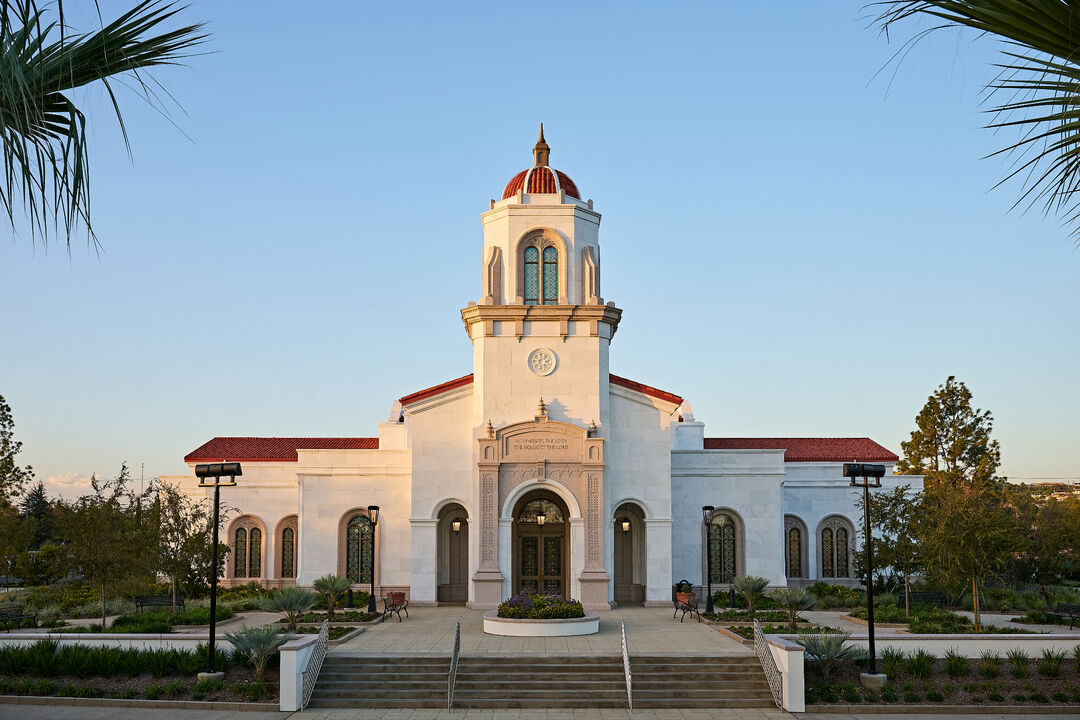
White Blanco Macael marble with pink and gray Rosa Porrino granite accentsArchitectural Features:
Single attached end towerOrdinance Rooms:
Two instruction rooms, two sealing rooms, and one baptistryTotal Floor Area:
30,872 square feet | 2,868 square metersHeight:
70 feet | 21.3 metersElevation:
361 feet | 110 metersTemple Facts
The Yorba Linda California Temple was the ninth temple built in California and the second built in Orange County, following the Newport Beach California Temple (2005).
Temple History
Announcement
On April 4, 2021, President Russell M. Nelson announced plans to construct the Yorba Linda California Temple at the 191st Annual General Conference. Yorba Linda, California is a suburban city in the United States about 35 miles southeast of downtown Los Angeles, named after the Yorba family that owned a 63,000-acre ranch in the early 1800s. Mormon pioneer setters first arrived in California in 1846 and the Mormon Battalion concluded their famous 2,080-mile march in San Diego in 1847. At the time of the announcement, more than 750,000 members of the Church resided in California in nearly 1,230 congregations. It would be the ninth temple in the Golden State with eight temples dedicated or under construction, including the Feather River California Temple, Fresno California Temple, Los Angeles California Temple, Newport Beach California Temple, Oakland California Temple, Redlands California Temple, Sacramento California Temple, and San Diego California Temple.1
Site
On July 15, 2021, the location was announced for the Yorba Linda California Temple as a 5.4-acre site at the intersection of Bastanchury Road and Osmond Street where an existing Church meetinghouse and baseball field are located. Plans called for a single-story building of approximately 30,000 square feet. The property is situated on a major thoroughfare near the The Imperial Highway, making it easily accessible for Orange County Saints in the area.2
Rendering
On September 17, 2021, the official exterior rendering was released for the Yorba Linda California Temple.
Groundbreaking
"It is an honor to be here on this beautiful California summer day to dedicate this site for the construction of a sacred temple," said Elder Mark A. Bragg, a General Authority Seventy, at the groundbreaking ceremony for the Yorba Linda California Temple held on Saturday, June 18, 2022. The 30,000-square-foot temple would be constructed on a 5.4-acre site at Bastanchury Road and Osmond Street where a former meetinghouse had recently been razed. It would be the second temple constructed in Orange County, joining the Newport Beach California Temple. In his site dedicatory prayer, Elder Bragg said, "We pray for Thy spirit to pour down on this area that we might dedicate our efforts to stay on the covenant path and to help others enter and stay on that path."3
Open House and Dedication
A public open house for the Yorba Linda California Temple was held from Thursday, April 30, through Saturday, May 23, 2026 (excluding Sundays). The event began with a media day held on Monday, April 27, followed by two days of tours for invited guests. The temple was dedicated on Sunday, June 7, 2026, at 10 a.m. with a rebroadcast at 2 p.m. The dedicatory session was broadcast to all units in the temple district.4
Temple Design
Exterior
The temple is constructed with structural steel and insulated concrete forms, clad in white Blanco Macael marble with pink and gray Rosa Porrino granite accents.
The property extends over 5.46 acres, enclosed by black ornamental aluminum metal fencing with marble and granite stone-clad pilasters.
Interior
Custom patterned carpet is used throughout the temple, with area rugs in select spaces, including a New Zealand wool rug in the bride’s room. The carpet was fabricated by Bentley Mills of City of Industry, California; Interface of Atlanta, Georgia; EcoPath of Chatsworth, Georgia; and Protexmatting of Denver, Colorado. It was installed by Commercial Flooring Systems of Salt Lake City, Utah. The area rugs were fabricated by Rugs International of Cartersville, Georgia, and installed by Commercial Flooring Systems.
The temple’s primary interior stone is Botticino Classico Extra marble, accented with BS Beige marble, Costa Esmeralda granite, Giallo Reale marble, Giallo Provenza marble, Rojo Alicante marble and Camel Beige Trani Verso limestone. The stonework was fabricated by Mármoles Gutiérrez Mena of Fines, Almería, Spain; Grupimar of Porriño, Pontevedra, Spain; and Marmi Ghirardi of Carpenedolo, Italy. It was installed by Carrara of City of Industry, California.
Decorative tile throughout the temple was fabricated by Rookwood Pottery of Cincinnati, Ohio; Adex USA of Doral, Florida; and Daltile of Dallas, Texas. It was installed by Carrara of City of Industry, California.
Warm neutral tones grace the temple walls, complementing the Spanish Mission design with hues of canvas tan, Greek villa and neutral ground. The paint was installed by Precision Wallcovering & Painting of San Juan Capistrano, California.
Decorative paint designs throughout the temple incorporate colors and patterns inspired by the local landscape and historic Spanish Mission buildings, featuring 24-karat gold leaf accents in select areas. The decorative paint was installed by Iconography Inc. of Salt Lake City, Utah.
Decorative light fixtures combine crystal with gold-colored metal, satin brass and plated stainless steel with acrylic lenses. The bride’s room features Murano glass fixtures. Crystal chandeliers and sconces illuminate key spaces throughout the temple, creating an atmosphere of sacred elegance. The lighting was fabricated by Sternberg of Roselle, Illinois; Preciosa Lighting of Dallas, Texas; Schonbek of Plattsburgh, New York; and Remains Lighting of Brooklyn, New York. It was installed by A.J. Kirkwood & Associates of Fullerton, California, and Zwick Construction of Murray, Utah.
Plain-sliced sapele veneer and plain-sawn sapele solids are used throughout the temple’s interior, with painted poplar and maple millwork in select areas. The millwork was fabricated and installed by Fetzer Architectural Woodworking of Salt Lake City, Utah.
The art glass was designed by Holdman Studios of Lehi, Utah; Sagrada Design Studio, Salt Lake City, Utah; HKS of Salt Lake City, Utah; and Michael Costantino. The patterns incorporate palm elements and rondels inspired by historic Spanish Mission architecture, with green, blue, soft white, orange and yellow hues and custom jewels. The art glass was fabricated and installed by Holdman Studios.
The interior doors are quarter-sawn sapele with art glass panels and US4 solid brass hardware. The hardware was fabricated by Rocky Mountain Hardware of Hailey, Idaho, and ASSA ABLOY of Stockholm, Sweden, and installed by Midwest D-Vision Solutions of Salt Lake City, Utah, and Fetzer Architectural Woodworking of Salt Lake City, Utah. Exterior doors were fabricated by Kawneer of Norcross, Georgia, and installed by Flynn of Salt Lake City, Utah. Interior doors were fabricated by Fetzer Architectural Woodworking of Salt Lake City, Utah, and Concept Millwork Corporation of London, Ontario, Canada, and installed by Fetzer Architectural Woodworking.
The baptismal font railings feature bronze metal with a satin brushed finish and clear tempered glass with decorative etching. They were fabricated and installed by Belt Metal Art+Design Studio of La Tebaida, Quindío, Colombia.
The temple’s ceilings feature gypsum board with decorative paint, millwork box beams and molding with glass-fiber-reinforced gypsum (GFRG) corbels and medallions, and acoustic ceiling tile. The box beams and trim were fabricated and installed by Fetzer Architectural Woodworking of Salt Lake City, Utah. The GFRG elements were fabricated by Unlimited Designs of Salt Lake City, Utah, and installed by Ironwood Commercial Builders of Concord, California.
The temple features four pieces of original artwork that celebrate sacred themes and the natural beauty of Southern California. Brad Aldridge’s “Hills in Springtime” captures the golden, rolling hillsides characteristic of the region. Geoff Krueger contributes two pastoral landscapes, “The Promise” and “The Long Row,” evoking the area’s historic orange groves and eucalyptus windbreaks. Elspeth Young’s “Joanna and the Risen Lord” portrays the resurrected Savior with one of His faithful disciples.
Church History in Yorba Linda
The story of The Church of Jesus Christ of Latter-day Saints in Yorba Linda is intertwined with the transformation of Southern California during the 19th and 20th centuries. In 1851, a group of over 400 Latter-day Saint pioneers arrived in what is now the San Bernardino region. These settlers—sent under the direction of Church President Brigham Young—had traveled from the Utah territory with wagons, livestock and supplies to establish a new colony in Southern California.
These Latter-day Saints were the first colonists to arrive in Southern California after it received statehood, drawing significant attention from locals. They bought a ranch adjacent to the property of Bernardo Yorba, whose family had settled the area. There they organized the first formal Church congregations in California, marking the beginning of an enduring Latter-day Saint presence in the region.
Community and Church Growth
As Southern California entered the late 19th century and early 20th, the region experienced steady growth in population, agriculture and economic development. During this time, The Church of Jesus Christ of Latter-day Saints also began to establish a more permanent presence in the area.
In the early 1980s, the Church purchased a five-acre parcel of land on Bastanchury Road in Yorba Linda. The front portion of the property was designated for a meetinghouse, while the remaining land was initially leased to a local nursery. The new meetinghouse was completed in 1984.
As membership continued to grow in the following decades, Church leaders considered how best to use the remaining portion of the property. In the early 2000s, local Church leader John C. Dalton IV proposed a plan to develop the unused back acreage. Drawing inspiration from a meetinghouse he had visited in Pasadena, where a ball field bordered by olive trees served youth and community activities, he suggested creating a similar space in Yorba Linda.
Church leaders in Salt Lake City approved the proposal on the condition that local members provide much of the funding and labor. Thanks to the combined efforts of the Anaheim East, Fullerton and Placentia stakes, a new ball field and pavilion were completed around 2010. For years, these facilities supported Boy Scouts, youth conferences, ward activities and community gatherings, becoming a cherished resource for local Church members.
In 2020, however, word spread that the Bastanchury meetinghouse property might be sold. Recognizing the significance of the land, local Church leaders compiled a detailed presentation outlining the property’s history, value and future potential. After carefully reviewing that information, Church leaders determined that the property should be retained—a decision members later viewed as providential.
Yorba Linda California Temple
On April 4, 2021, Church President Russell M. Nelson announced that a new temple would be built in Yorba Linda—the ninth temple in California and the second in Orange County. A few months later, local Latter-day Saints were delighted when the Church announced that the temple would be located on the site of the Bastanchury meetinghouse.
Ground was broken for the temple on June 18, 2022, by Elder Mark A. Bragg, President of the Church’s North America West Area. Nearly 500 guests, including community officials and interfaith leaders, attended the event, which was also broadcast to members throughout the region. Among the honored guests was Lisa Yorba Amerling, a descendant of the original Yorba family whose ancestral land now hosts the temple.
Just under four years later, the temple stood complete—a new sacred space in the heart of Yorba Linda. True to the city’s motto, “The Land of Gracious Living,” the support shown by city leaders and residents throughout the planning and construction process has reflected an atmosphere of goodwill and respect. At the groundbreaking, Elder Bragg said: “I promise you that this house of the Lord will represent the highest in gracious living, and those who enter will leave with a higher commitment to gracious living. I promise those who visit will feel the spirit of higher and gracious living as they stand on this sacred ground. We commit to being neighbors of gracious living.”
- The Church of Jesus Christ of Latter-day Saints News Release, "At April 2021 Conference, Prophet Announces 20 More Temples to Be Constructed," 4 Apr. 2021.
- "Location Announced for a New Temple in California," The Church of Jesus Christ of Latter-day Saints News Release, 15 Jul. 2021.
- "Ground Broken for Yorba Linda California Temple," The Church of Jesus Christ of Latter-day Saints News Release, 18 Jun. 2022.
- "Milestones for Temples in California, Guatemala, Mozambique and Utah," The Church of Jesus Christ of Latter-day Saints News Release, 12 Jan. 2026.