Bacolod Philippines Temple
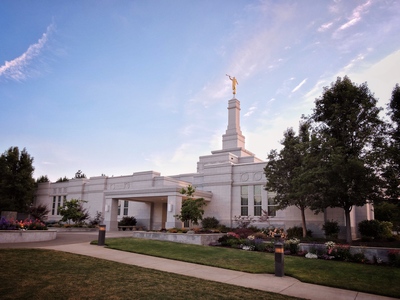
Yorba Linda California Temple
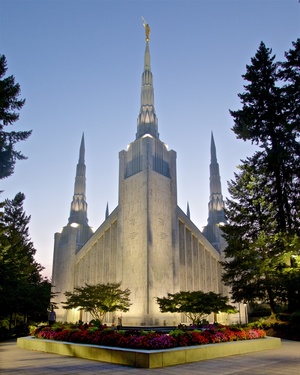
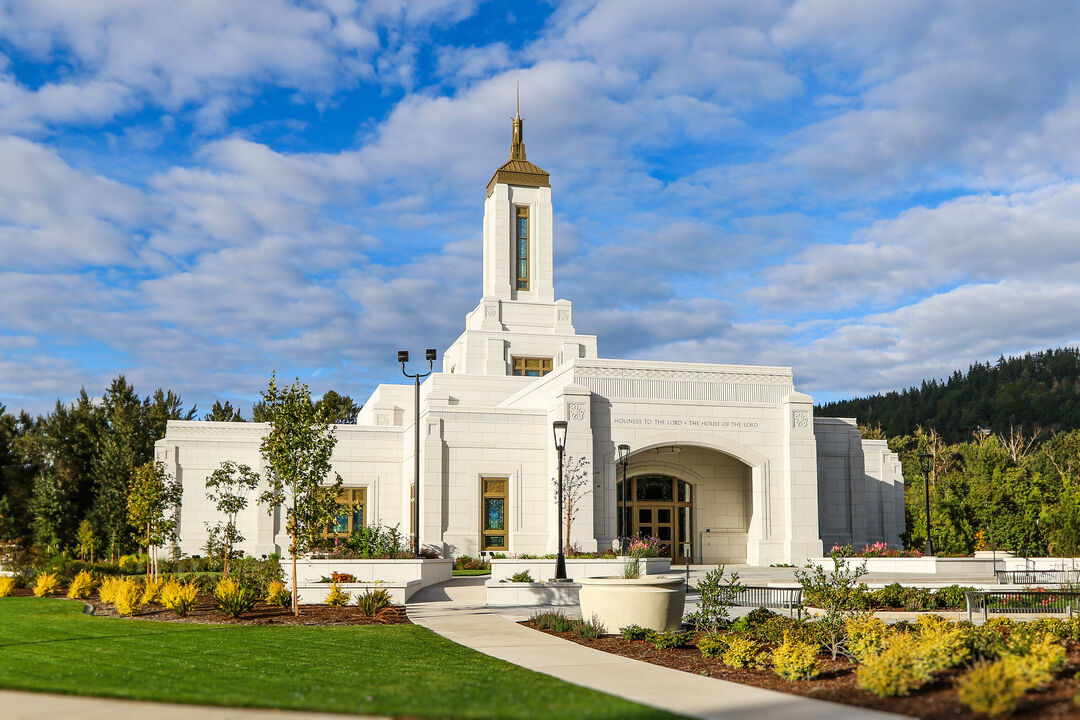
Willamette Valley Oregon Temple
218th dedicated temple in operation
© John Sperry. All rights reserved.
Services
NO visitors' center open to the publicNO arrival center available
NO patron housing available
Distribution center on site (Store Locator)
Announcement:
4 April 2021Groundbreaking and Site Dedication:
29 October 2022 by Valeri V. CordónPublic Open House:
23 April–9 May 2026 | 16 daysDedication:
7 June 2026 by Dieter F. UchtdorfSite:
10.29 acres | 4.2 hectaresExterior Finish:
Stone fabricated by Grupimar of SpainArchitectural Features:
Single attached central spireOrdinance Rooms:
Two instruction rooms, two sealing rooms, and one baptistryTotal Floor Area:
30,635 square feet | 2,846 square metersHeight:
119 feet | 36.3 metersElevation:
429 feet | 131 metersTemple History
Announcement
On April 4, 2021, President Russell M. Nelson announced plans to construct the Willamette Valley Oregon Temple at the 191st Annual General Conference. Oregon, a state in the western United States, was home to nearly 154,000 members of The Church of Jesus Christ of Latter-day Saints. Latter-day Saint settlement largely began with the arrival of Latter-day Saint businessmen in 1887. They built a lumber mill on North Powder River and persuaded several hundred Latter-day Saint families to migrate to Oregon. There were approximately 300 congregations across the state at the time of the announcement. The Willamette Valley Oregon Temple was the third in the state, with other temples in Portland and Medford.1
Site
On September 2, 2021, the location of the Willamette Valley Oregon Temple was announced. The temple would be constructed on a 10.5-acre site located at the intersection of International Boulevard and Corporate Way in Springfield, Oregon, a suburb of Eugene, near the wooded hills bordering the McKenzie River.
Rendering
On September 2, 2021, the official rendering of the Willamette Valley Oregon Temple was publicly released.
Groundbreaking
Elder Valeri V. Cordón, first counselor in the North America West Area presidency, presided at the groundbreaking for the Willamette Valley Oregon Temple on Saturday, October 29, 2022. The 30,000-square-foot temple will be constructed on a 10.5-acre site at the intersection of International Boulevard and Corporate Way in Springfield. Construction began the following Monday, October 31, and was anticipated to last two to three years. In his dedicatory prayer, Elder Cordón said: "We pray that the temple will be a beacon of hope and peace that inspires this community to come unto Christ even in its construction phase."2
Open House and Dedication
A public open house for the Willamette Valley Oregon Temple was held from Thursday, April 23, through Saturday, May 9, 2026, excluding Sundays. The event was preceded by a media day on Monday, April 20, followed by two days of tours for invited guests. Elder Dieter F. Uchtdorf of the Quorum of the Twelve Apostles presided at the dedication on Sunday, June 7, 2026, at 10:00 a.m. The dedicatory session was broadcast to all units in the temple district and rebroadcast at 2:00 p.m.3
Temple Design
Exterior
The temple is constructed with insulated concrete forms and structural steel. The exterior stone was fabricated by Grupimar of Spain and installed by IMS Masonry of Lindon, Utah.
The property extends over 10.29 acres, enclosed by an ornamental steel fence.
The temple’s design motifs draw from the lush Pacific Northwest landscape, featuring the mountain laurel and repeating prism patterns throughout the exterior stone, interior millwork and decorative painting. The art glass reflects the green vegetation and blue water of the nearby McKenzie and Willamette Rivers, connecting the temple to Oregon’s natural beauty.
Interior
Soft gold and green patterned carpets are used throughout the temple, with white sculpted broadloom in the sealing and celestial rooms and solid green pile in the administration area. Custom nylon rugs appear in the bride’s room and in the entry and waiting areas. The carpet was fabricated by Mannington Mills of Calhoun, Georgia, and Bentley Mills of City of Industry, California, and installed by Re:Source Utah in Salt Lake City. The area rugs were fabricated by Rugs International of Cartersville, Georgia.
The temple’s primary interior stone is BS Beige E1 marble from Italy, accented with gold, green and blue stones from Italy and Brazil. The stone wall base throughout is Breccia Aurora Light from Italy, with the celestial and sealing rooms featuring White V marble from Vietnam and Italy. The interior stonework was fabricated by Ghirardi Marmi of Italy and installed by Western Tile & Marble of Redmond, Washington.
Decorative tile throughout the temple was manufactured by Adex, Daltile and Marazzi and installed by Western Tile & Marble of Redmond, Washington.
The temple walls feature white and beige tones, creating a warm and inviting atmosphere. The celestial and sealing rooms feature vinyl wallcoverings with a fine organic raised pattern, while the baptistry and instruction rooms display horizontal striated linen patterns. The bride’s room features a subtle vertical linen pattern. The paint was applied by Pro Classic Painting of Aurora, Colorado.
Decorative paint designs throughout the temple incorporate mountain laurel and prism motifs, appearing on pilaster capitals, decorative friezes and altars. The decorative paint was fabricated and installed by Allen Décor of Logan, Utah, and David Horne of Cottonwood Heights, Utah.
Crystal chandeliers illuminate the bride’s room, celestial room and sealing rooms, creating an atmosphere of sacred elegance. Frosted glass fixtures with bronze accents appear in all other areas. The lighting was fabricated by Preciosa Lighting of Dallas, Texas, and the Czech Republic, and Schonbek Lighting of Plattsburgh, New York. It was installed by OEG of Eugene, Oregon.
Stained cherry wood is used throughout the temple’s interior, with paint-grade maple and poplar in select areas. The mountain laurel and rectangular geometric motifs are featured on millwork throughout the interior. The millwork was fabricated and installed by Fetzer Architectural Woodworking of West Valley City, Utah.
The art glass was designed by the Church’s design team and Holdman Studios. The patterns reference the green vegetation and blue water of the nearby McKenzie and Willamette Rivers. They also feature gold, purple, pink, green and a blue-yellow gradient, accented by frosted jewels. The art glass was fabricated and installed by Holdman Studios of Lehi, Utah.
The interior doors are stained cherry with art glass panels and brass hardware. The hardware was designed by HKS, fabricated by ASSA ABLOY and installed by Architectural Building Supply of Salt Lake City, Utah. Interior doors were milled and assembled by Precision Millwork of Springville, Utah, with finishing and installation by Fetzer Architectural Woodworking of West Valley City, Utah. The main entry exterior doors were fabricated by MK Architectural Metal of North Canton, Ohio, and installed by Insight Glass of Benicia, California.
The baptismal font railings are made of brass with clear and frosted glass panels. They were fabricated and installed by Hanset Stainless of Portland, Oregon.
The temple’s ceilings feature gypsum board and acoustic ceiling tiles. The framing and drywall were installed by Mid-Valley Commercial Construction of Salem, Oregon.
The temple features two original paintings by Utah artist Michael Coleman that reflect the natural beauty of Oregon’s landscape. “Proxy Falls” depicts the iconic waterfall located in the Three Sisters Wilderness, with its misty atmosphere and lush green surroundings. “Oregon White Oak” features the state’s signature tree standing majestically against a dramatic sky with a rainbow, reflecting the region’s verdant meadows and ever-changing weather.
Willamette Valley Church History
Early History
The roots of The Church of Jesus Christ of Latter-day Saints in the southern Willamette Valley trace back to the early 1900s. In 1909, three Latter-day Saint families moved to the Eugene area, joining another family living there. The four families organized a Sunday school under the authority of the mission president of the Northern States Mission. Missionaries were sent to the area to share the gospel and help facilitate meetings, which were held in homes or rented rooms behind an auto dealership.
On August 4, 1929, 76 members of the Church gathered in the Woodmen of the World hall and were organized as the Eugene Branch (equivalent to a small parish). Members traveled from as far as Roseburg, Corvallis, Coos Bay, Coburg and Springfield to attend.
Church Growth
By 1930, Church membership in Oregon had grown to 3,230. In the Willamette Valley, the members were outgrowing their rented spaces, and in 1937 the Eugene Branch was counseled to build their own meetinghouse. At the time, the members were responsible for contributing 100 percent of the costs and most of the labor. Within a few months, they had purchased a city lot on the corner of 10th and Tyler in Eugene. On June 26, 1938, the Portland Stake (similar to a diocese) was organized, and on the same day, the Eugene Branch was made into a ward, or a local congregation, in that stake.
Over the next few decades, the Church continued to grow as missionary work progressed. Its growth was also affected by Latter-day Saints relocating to the area to work in the booming timber industry, farm the fertile valley or teach and study at the area’s institutions of higher learning, now known as University of Oregon and Oregon State University.
In 1951, the Willamette Stake was created. It extended from Salem in the north to Myrtle Creek in the south and included Lebanon, Sweet Home, Albany, Corvallis, Eugene, Cottage Grove and Roseburg. The first stake center in Eugene was built in 1972 at 1155 President Street.
As the Church grew, members raised funds for building by selling fireworks, harvesting and selling walnuts and putting on theatrical productions. The buildings they raised were equipped with kitchens, gymnasiums, stages, chapels and beautiful pipe organs. The Eugene Stake Center, located at 3500 West 18th Avenue, contains a wooden pipe organ built by a local member of the Church.
In 1967, an institute of religion was built near the University of Oregon campus to serve the needs of university students. This building quickly became a gathering place for religious instruction and social events. One notable PhD graduate at the university, Jerold Ottley, went on to lead the famed Mormon Tabernacle Choir for 25 years, from 1974 to 1999.
In 1984, the Church announced that it would build its first temple in Oregon. The Portland Oregon Temple, located in Lake Oswego, was dedicated in August 1989. The Medford Oregon Temple was dedicated in April 2000.4
- The Church of Jesus Christ of Latter-day Saints News Release, "At April 2021 Conference, Prophet Announces 20 More Temples to Be Constructed," 4 Apr. 2021.
- "Ground Broken for Willamette Valley Oregon Temple," The Church of Jesus Christ of Latter-day Saints News Release, 31 Oct. 2022.
- "Open House and Dedication Dates for Temple in Oregon," The Church of Jesus Christ of Latter-day Saints News Release, 24 Nov. 2025.
- "Willamette Valley Media Day Press Kit," The Church of Jesus Christ of Latter-day Saints News Release, 20 Apr. 2026 <https://newsroom.churchofjesuschrist.org/multimedia/file/Willamette-Valley-Media-Day-Press-Kit.pdf>.